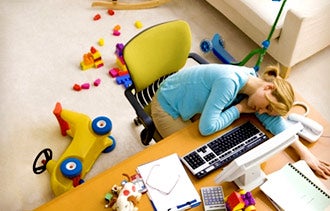
Showing posts with label work from home. Show all posts

Friday, 29 March 2013

Yahoo has banned its staff from working from home


Yahoo has banned its staff from "remote" working. After years of many predicting working from home as the future for everybody, why is it not the norm?

When a memo from human resources dropped into the inbox of Yahoo staff banning them from working from home it prompted anger from many of its recipients.
"Some of the best decisions and insights come from hallway and cafeteria discussions, meeting new people, and impromptu team meetings," the memo said.
"Speed and quality are often sacrificed when we work from home."
The move to get staff back into the office from June this year is thought to have been driven by new chief executive Marissa Mayer, who herself returned to work weeks after giving birth.

Virgin entrepreneur Richard Branson, who spends much of his time working on Necker Island in the Caribbean, was quick to respond, calling it a "backwards step in an age when remote working is easier and more effective than ever".
People in the West are constantly bombarded by news about technology that makes it easier to communicate with the office. Many have fast broadband and webcams that allow their faces to appear through the ether at any important meetings. They are surrounded by smartphones, laptops and tablets.
Everything is surely there to free them from the daily commute. Those in manufacturing or retail might always have to be present, but in an age when so many work in offices, why can't they have their office space at home?

What is telecommuting?the increase in the UK, according to the CBI. A total of 59% of employers who responded to a survey in 2011were offering teleworking, up from 13% in 2006.

  • Use of personal computers and phones to enable a person to work from home while maintaining contact with customers or a central office
  • Also known as teleworking, remote working and working from home
  • TUC figures show it's most common among older people, with one in five workers aged over 55 regularly working from home
  • Full-time workers more likely to do it than part-timers, and those with dependent children, says the Work Foundation
  • Number of countries encourage it to help employees' work/life balance
  • But some work five to seven more hours a week at home than if in a regular office setting, a recentUniversity of Texas study shows
There are signs that the number of people working from home is on 
Working from home
In the US, 24% of employed people report working from home at least some hours each week, according to the Bureau of Labour Statistics.
But only 2.5% of the workforce (3.1 million people, not including the self employed or unpaid volunteers) consider home their primary place of work, says the Telework Research Network.
Yahoo is not a lone voice in espousing the virtues of physically being in the office.
Only last week Google's chief financial officer Patrick Pichette said when the company is asked how many people telecommute, their answer is "as few as possible".
"There is something magical about sharing meals," Pichette explained. "There is something magical about spending the time together, about noodling on ideas, about asking at the computer 'What do you think of this?'"
Google workers are provided with a free wifi-enabled bus in to the HQ. Mayer, of course, is a former Google executive.
There are obvious reasons why working from home has not proliferated in the way people thought it might. There is still ingrained cultural antipathy.
Designers at Google HQGoogle, like Yahoo, prefers its workers in the office
Not "being seen in the office" may affect a person's chances of promotion, result in a smaller pay rise than office-based peers and lower performance evaluations, according to research by the London Business School and the University of California.
They stress the continuing importance of so-called "passive face time" that is being in the office, regardless of what someone is doing.

The additional pressure not to be perceived as "skiving" may drive those who do work from home to exceed their hours.
Prof Jennifer Glass, co-author of a report on the US workforce published by the University of Texas at Austin, says for many people, especially those in their 30s and 40s, teleworking is part of their work after they have already done 40 hours in the office.
Glass was "flabbergasted" by the Yahoo memo. "This seems to be trying to bring Yahoo in line with corporate America, not high-tech industries," she says.
"The idea that this is going to promote more innovation seems bizarre."
Promoting the value of interactions in hallways and canteen seems strange at a time when face-to-face contact within the office is decreasing.
"I frequently email someone without getting up to see if they are there," Glass notes.
Managers can be biased in favour of those they can actually see working.
"There is this attitude that managers need to see people are close by and that those workers are more productive," says Glass. "It is a natural tendency to want to control things."
Commuters head to work on bikes and on footOne perk of teleworking is no more commuting
This seems outdated to many. "The best employers don't overlook staff because they are not in the office. That strikes me as yesterday's way of working," says Paul Sellers, policy adviser at UK trade union umbrella group the TUC.
Dame Stephanie Shirley, who pioneered home working in the computer industry in the early 1960s, says the concept has not taken off in quite the way many predicted at the time.
"Academics were predicting it would become more acceptable. Town planners were starting to incorporate the idea of home working into their designs. It felt like the beginning of a different kind of society."

When she started her company F International in 1962, the idea of people working from home was alien to most businesses. Offices were highly regimented. Some of the company's programmers did not even have home telephones.
Workers were used to signing in and having their output closely supervised. "It was about the time you were present, rather than what you had achieved," says Dame Stephanie.
By the mid-1980s F International was a pioneer of teleworking employing 800 home workers and turning over nearly £20m a year, and was setting up a national electronic mail network to link workers' home computers to the company's minimal headquarters.
Dame Stephanie said she was on a "crusade" to find skilled work for women who had left the workplace to start families or look after relatives.
But social changes can take longer than expected, says the 75-year-old, who quit the industry in 1993.
Decades later the issue has not gone away. Working from home still has its image problem.
London Mayor Boris Johnson once joked: 'We all know that is basically sitting wondering whether to go down to the fridge to hack off that bit of cheese before checking your emails again."
For Alan Denbigh, co-author of The Teleworking Handbook and former executive director of the Telework Association, there are proven benefits of home working. "It gives you the opportunity to get on with a particular project and for those who are bringing up small families where it is imperative to have a degree of flexibility it works."
Having done both he does not recommend working from home exclusively, recognising the benefits of interacting with people in the office and the pitfalls of working long hours at home to keep up.
But he says it is "equally ridiculous" to feel you have to be at the office every day. He recommends a bit of both.
"A large corporation saying you can't work at home, especially an IT based company, seems counter-productive. You have to treat people as grown-ups."
Additional reporting by Brian Wheeler


Monday, 25 March 2013

why you should start blogging


Blogging is becoming more and more popular everyday. Should you join the blogosphere? Take a look at this list to help you make your decision about blogging.

1. To Express Your Thoughts and Opinions

You have something to say, and blogs provide a place to say it and be heard.


3. To Help People
2. To Market or Promote Something

Blogging is a great way to help market or promote yourself or your business, product or service.
Many blogs are written to help people who may be going through similar situations that the blogger has experienced. Many parenting and health-related blogs are written for this purpose.

4. To Establish Yourself as an Expert

Blogs are wonderful tools to help bloggers establish themselves as experts in a field or topic. For example, if you're trying to get a job in a specific field or hoping to publish a book on a specific topic, blogging can help legitimize your expertise and expand your online presence and platform.

5. To Connect with People Like You

Blogging brings like-minded people together. Starting a blog can help you find those people and share your opinions and thoughts.

6. To Make a Difference

Many blogs are issue-based meaning the blogger is trying to provide information to sway people's thinking in a certain direction. Many political blogs and social issues blogs are written by bloggers who are trying to make a difference in their own ways.

7. To Stay Active or Knowledgeable in a Field or Topic

Since successful blogging is partially dependent on posting frequency and providing updated, fresh information, it's a perfect way to help a blogger stay abreast of the events in a specific field or topic.

8. To Stay Connected with Friends and Family

The world has shrunk since the Internet has become more accessible. Blogs provide a simple way for family and friends to stay connected from different parts of the world by sharing stories, photos, videos and more.

9. To Make Money

It's important to point out that most bloggers don't make a lot of money blogging, but the potential does exist to generate revenue from your blog with hard work and commitment. There are many bloggers who bring in big bucks. With patience and practice, you can make money through advertising and other income-generating activities on your blog.

10. To Have Fun and Be Creative

Many people start a blog simply for fun. Perhaps a blogger is a fan of a particular actor or loves knitting and wants to share that passion through a blog. One of the most important keys to successful blogging is having a passion about your blog's topic, so you can write prolifically about it. Some of the best and most interesting blogs started out as blogs that were written just for fun and to give the blogger a creative outlet.
    Susan Gunelius
  • original article by
  •  

Monday, 18 March 2013

8 Mistakes to Avoid When Starting a Business From Home.

8 Mistakes to Avoid When Starting a Business From Home
Launching a business from home can provide tremendous flexibility and the kind of work-life balance that we all crave. But the reality is that home businesses bring their own set of challenges, says Caroline Daniels, lecturer for entrepreneurship and technology at Babson College in Wellesley, Mass. For example, "doing your business on your own from home can get stale. It's hard to keep feeding the imagination all on your own."
Here are eight mistakes to avoid when starting a business from home:
Spending Too Much Time at Home: Loneliness is the number one complaint from people who work at home, says Anne Alexander, a small-business coach in Brevard, N.C. "Many people are not prepared for the isolated working environment." While it may seem easier to do everything virtually, that isn't the best approach. Instead, take time away from your home office for face-to-face meetings that will help build your business. Plan lunch dates, attend networking groups or work from coffee shops to build a social element into your day, Alexander says
Keeping a 24-7 Work Schedule: When Leon Oks co-founded iCanvasART, an online seller of custom canvases, he and several employees spent day and night working from his dining room. It's a recipe for burnout. "You're feeling guilty that you're not working, and there's no disconnect," Oks says. Eventually, he asked employees to leave by 6 p.m. and made sure to schedule free time into his day. But this year, he moved his Niles, Ill.-based company to an office space because the growing business was becoming difficult to manage at home.
Allowing Interruptions: Without a boss breathing down your neck, it's easy to take a phone call or two from family and friends. But when you're constantly in "interrupt mode," it hurts your business focus, Daniels says. To combat disruptions, she recommends setting aside blocks of quiet time throughout the day when you don't allow phone calls or email alerts. You also need to be careful about getting pulled too often into distracting chores like laundry or childcare. Remind family members and babysitters of your work hours and explain you'll be answering only urgent requests.
Depending Too Much on Loved Ones: Without coworkers around, you can easily fall into a habit of talking out your business problems with your spouse or friends. But loved ones may get weary of talking about your business. What's more, they may not provide the best advice because they don't always understand your business, Alexander says. So, try to connect with others in your field to develop an informal network of advisors. "Build a mastermind group of others with home-based businesses," Alexander suggests.
Failing to Create a Separate Work Area: Even if you don't live in a huge home, set aside a space reserved almost entirely for work. Opt for a little-used room or even an empty corner of your living area to create a physical divide between work and home. If you must work in a common area of the house like the dining room or kitchen, put away personal objects to set a professional tone for the day, Daniels says. "Even if you don't have a separate space, you can create it."
Letting Employees Abuse Your Home: You risk damage to your home if you don't establish rules for how employees should behave there. For example, Oks got stressed out over how his workers would eat lunch in his living room, walk on his light-colored carpet with their shoes on, and tack notes onto the walls. Instead of scolding employees later, it's better to set expectations from the get go, Oks says. "Set up rules you're comfortable with." Oks began asking employees to take off their shoes and clean off their workspace at the end of the day so he could use his dining room table each evening.
Getting too Busy to Stay Organized: As work piles up, it's easy to let organization slide, says Tata Harper, who started an eponymous skincare line at her home in Shoreham, Vt. "It is easy to succumb to disorganization when you are working in the same place that you live since it is a private space that you don't often share with" coworkers or other visitors, she says. Harper files papers away before they pile up and stores only business-related items there. In addition, she finds that decorating and brightly lighting her office motivates her to keep it clean.
Starting the Day Without a Plan: "Without conscious decisions about how to spend your time, your day can slip away without much to show for it," says Elaine Quinn, Chicago-based author of There's No Place Like Working From Home (Calloran Publishing, July 2011). Instead, give time to both short-term actions and long-term goals so you run your business in a more balanced manner. Create a schedule and stick to it. "Rather than making to-do lists, enter tasks directly into your [daily] planner," which allows you to set a specific deadline for completing each task, Quinn says. Also, make sure you leave unscheduled time in the day to deal with important but unexpected issues that crop up.


Read more: http://www.entrepreneur.com/article/224875#ixzz2NulTdQYd